
Tooth filling: what it is, what the procedure involves, and how to know when you need one
A tooth filling is one of the most common dental procedures there is, and one of the most misunderstood. Patients often arrive knowing only that they need one, not what will happen, what material will be used, or how long the result should last. Others delay getting one because they are not sure the tooth actually needs treatment yet, or because they are anxious about the procedure itself.
Both situations are worth addressing, because the consequences of delaying a filling when one is needed are straightforward and entirely avoidable. A small cavity that could have been restored with a minimal filling today becomes a larger one tomorrow, eventually reaching the nerve and requiring root canal treatment or extraction. The tooth filling that prevents that progression takes one appointment and, at Hakimi Dental Clinic in Oldbury, starts from just £75.
This guide covers what a tooth filling is, the types of filling material available and what distinguishes them clinically, what the procedure actually involves step by step, how to look after a filling once it is placed, and the signs that an existing filling needs attention.
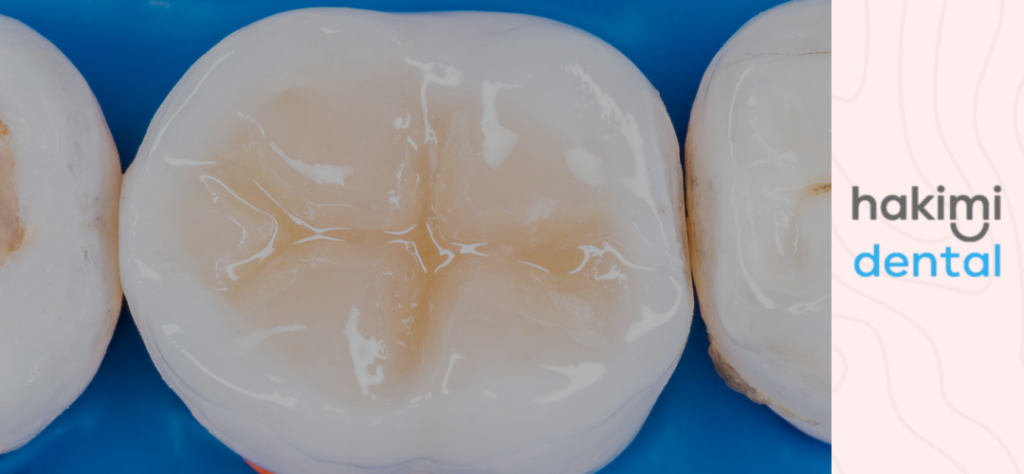
What a tooth filling is and when it is needed
A tooth filling is a dental restoration placed to repair a tooth that has been damaged by decay, fracture, erosion or wear. The procedure involves removing the damaged or decayed portion of the tooth, cleaning and preparing the remaining tooth structure, and placing a restorative material that seals the cavity and restores the tooth to its original shape and function.
The most common reason for a tooth filling is dental caries (tooth decay). Decay is caused by the acid produced by bacteria in dental plaque when they ferment sugars: this acid demineralises the enamel surface and, if left unchecked, progressively destroys the tooth structure beneath. A filling replaces what has been lost and seals the cavity against further bacterial penetration.
Other situations requiring a dental filling include:
- A fractured or chipped tooth where the break is not severe enough for a crown but leaves the tooth exposed and sensitive
- Worn tooth surfaces from grinding or acid erosion where the enamel has thinned to the point where sensitivity and structural vulnerability require restoration
- Replacing an old or failing filling that has cracked, come loose, or developed secondary decay at its margins
The key clinical principle: a filling placed early, when decay is still confined to the enamel or the outer dentine, is smaller, less invasive and cheaper than a filling placed when decay has progressed deeper. This is the consistent clinical argument for attending dental check-ups at regular intervals, because early decay is detected before it produces symptoms.
Types of tooth filling material: what is different about each
The material used for a tooth filling is not a single universal choice. Different materials have different properties, different clinical indications, and different aesthetics. Understanding them helps you know what to expect.
Composite resin (tooth-coloured filling)
Composite resin is the most widely used filling material in modern general dentistry for visible teeth and increasingly for back teeth as well. It consists of a resin matrix (typically Bis-GMA) combined with inorganic filler particles, producing a material that is tooth-coloured, directly placed, and hardened with a blue LED curing light.
Why composite is now the preferred choice for most fillings:
It bonds directly to the tooth structure through an adhesive protocol, which means less healthy tooth needs to be removed compared to amalgam. Because composite bonds to what remains, it actually reinforces the surrounding tooth walls rather than simply filling a space within them.
It is matched to the shade of the natural tooth so precisely that a well-placed composite filling is essentially invisible. For front teeth, this is clinically obvious as the benefit. For back teeth, many patients now prefer composite for the same reason, particularly in visible premolars.
It is placed directly in the surgery in a single appointment, without any laboratory stage.
At Hakimi Dental Clinic, composite tooth fillings start from just £75, making them one of the most accessible composite filling prices in Oldbury and the surrounding Birmingham area.
Amalgam (silver filling)
Dental amalgam is an alloy of mercury, silver, tin and copper that has been used in dentistry for over 150 years. It is exceptionally durable and was the standard restorative material for back teeth for decades.
However, amalgam is now being phased out across the UK following the Minamata Convention, an international treaty restricting mercury use in manufacturing and medicine. The EU implemented a phased ban on dental amalgam beginning in 2026, with certain exemptions. Many UK dental practices, including Hakimi Dental Clinic, have already moved away from amalgam entirely in favour of composite and other tooth-coloured materials.
If you have existing amalgam fillings, these do not typically need to be replaced unless they are failing. Removing sound amalgam unnecessarily exposes the patient to a brief, transient mercury release that is not clinically indicated without a treatment reason.
Glass ionomer cement (GIC)
Glass ionomer cement is a tooth-coloured material that releases fluoride into the surrounding tooth structure, which provides ongoing protection against secondary decay. It bonds chemically to dentine and enamel.
Its limitations are that it is considerably less wear-resistant than composite and does not produce the same aesthetic result. Glass ionomer is most useful clinically for fillings in areas of low biting force, for cavity lining beneath other materials, for root surface cavities where moisture control is difficult, and for certain paediatric applications.
Ceramic and indirect restorations
For very large cavities where a conventional direct filling would not provide adequate strength and longevity, ceramic inlays, onlays or overlays may be the appropriate choice. These are fabricated in a laboratory from the impression or digital scan of the prepared tooth and bonded in place at a second appointment.
The advantage is superior strength, longevity and aesthetics compared to even a large direct composite. The disadvantage is cost and the requirement for a second appointment. For large restorations on molar teeth, this indirect approach often produces a better long-term outcome than an oversized direct composite filling.
The tooth filling procedure: what happens at each stage
Most patients have some anxiety about having a filling, which tends to stem from uncertainty about what will happen rather than the procedure itself. Here is exactly what a tooth filling procedure at Hakimi Dental Clinic involves.
Stage 1: Anaesthesia
For any filling that reaches the dentine, local anaesthetic is administered to ensure complete comfort throughout the procedure. A topical anaesthetic gel is applied to the gum surface for approximately 60 seconds before the injection, which significantly reduces or eliminates the sensation of the needle. The injection is administered slowly and precisely, and within two to three minutes the area is numb.
For very small enamel-only restorations, local anaesthetic may not be needed because enamel has no nerve supply. The clinician will advise.
Stage 2: Decay removal and cavity preparation
Using a dental handpiece (drill) and hand instruments, the decayed and damaged tooth structure is removed. The cavity is cleaned to ensure no residual decay remains, as leaving any behind beneath the filling leads to continued decay and eventual failure. The preparation is shaped to provide appropriate retention and support for the filling material.
Modern minimally invasive techniques aim to remove as little healthy tooth structure as possible: composite bonding to the tooth means less preparation is needed than with amalgam, and this conservative approach preserves more of the natural tooth.
Stage 3: Bonding and composite placement
For a composite tooth filling, the cavity is etched with a mild phosphoric acid gel for 15 to 30 seconds to create a micro-porous enamel surface, then rinsed and dried. A bonding agent is applied and light-cured, creating the adhesive interface between the tooth and the composite.
Composite is then placed in increments, typically in 2mm layers. Each layer is shaped and light-cured before the next is added. This incremental placement reduces the polymerisation shrinkage stress within the restoration and allows the cavity to be filled accurately. The final layer is contoured to match the natural tooth anatomy.
Stage 4: Bite check and polishing
Once the filling is placed and hardened, the bite is checked using articulating paper, which marks where the filling contacts the opposing teeth. Any high spots are adjusted until the bite feels natural in all jaw positions. The filling is then polished using a sequence of polishing discs and cups that produce a smooth, glossy surface that is more resistant to staining and more comfortable to the tongue.
Total appointment time: A small single-surface composite filling typically takes 30 to 45 minutes. Larger, multi-surface fillings take longer.
How long does a tooth filling last?
A question every patient asks, and one with an honest variable answer. The lifespan of a tooth filling depends on several factors:
- The size and location of the filling: Smaller fillings in lower-stress locations last longer than large fillings on molar biting surfaces subject to heavy chewing forces. A two-surface filling on a molar needs to be more robust than a small edge chip repair on a front tooth.
- The material used: Composite fillings typically last eight to twelve years with good care. Ceramic inlays and onlays last longer. Amalgam, where it remains in place from previous treatment, can last twenty or more years.
- The patient’s habits: Tooth grinding (bruxism) accelerates filling wear dramatically. A patient who grinds at night without a night guard may chip or wear through a composite filling considerably faster than the expected lifespan. Biting on very hard foods, chewing ice and using teeth as tools all increase filling wear.
- Oral hygiene: Secondary decay at the filling margins (where the filling meets the natural tooth) is the most common cause of filling failure. Consistent brushing and interdental cleaning prevents this. Regular dental hygienist appointments remove the calculus and bacterial biofilm at filling margins that home cleaning does not fully address, extending the lifespan of restorations.
- Regular assessment: The condition of existing fillings is reviewed at every dental check-up, allowing early identification of marginal breakdown, wear or secondary decay before they have progressed to the point where a more complex restoration is needed.
Signs that a tooth filling needs replacing
Between check-up appointments, certain symptoms suggest a filling needs clinical attention:
Sensitivity or pain when biting: A filling that has cracked, fractured or shifted may produce sharp pain specifically when biting down on that tooth. This is a signal that the integrity of the restoration has been compromised.
A visible gap or dark line around the filling: The margin between the filling and the tooth surface should be seamless and no darker than the surrounding tooth. A visible gap or dark discolouration at the margin suggests breakdown at the seal, which allows bacteria to access the cavity beneath the filling.
The filling feels rough or sharp: A smooth, polished filling surface can develop roughness as composite ages or as small chips occur at the edges. A sharp edge that catches the tongue or cheek needs assessment and adjustment.
A persistent sweet or sensitivity to cold on a previously settled tooth: If a tooth with a filling that was comfortable suddenly develops sensitivity, particularly to sweet foods, this is a clinical indicator of possible secondary decay or marginal breakdown.
The filling has come out entirely: A lost filling is not a life-threatening emergency but it does need attention within a day or two. The exposed cavity is sensitive and vulnerable to further decay. In the short term, dental repair cement from a pharmacy provides a temporary seal. For same-day assessment, the emergency dental service at Hakimi Dental Clinic is available from just £25.
The cost of a tooth filling at Hakimi Dental Clinic, Oldbury
As of July 2026, dental fillings at Hakimi Dental Clinic start from just £75 for a composite tooth filling. This is one of the most accessible filling fees for private dentistry in Oldbury and the wider Birmingham area, without compromising on the quality of material or technique.
The final cost of a specific filling depends on the size of the cavity (number of surfaces involved), the location of the tooth, and the time required. At the assessment appointment, the cost of the recommended treatment is confirmed before any work is carried out. There are no surprises.
For context: the cost of a tooth filling today is considerably less than the cost of treating the same tooth if decay is left to progress to a point where root canal treatment, a crown or extraction becomes necessary. The filling protects the investment in the tooth; it does not just fix the immediate problem.
The bottom line
A tooth filling is one of the most reliable and time-tested procedures in dentistry. When decay is caught early and a filling is placed before it reaches the nerve, the tooth can serve well for another decade or more with appropriate care. What determines the quality of that outcome is the skill of the clinician, the material chosen, the technique used, and the maintenance that follows.
At Hakimi Dental Clinic in Oldbury, dental fillings are available from just £75, dental check-ups from £35, and emergency appointments from £25 seven days a week for urgent situations. Wherever you are in the process, the team at 51a New Birmingham Road, B69 2JF is here.
Disclaimer
The information in this article is intended for general educational guidance only and does not constitute personalised dental advice. For concerns about tooth decay or an existing filling, please book an appointment with a qualified dental professional for a proper clinical assessment.
Hakimi Dental Clinic is a dental practice at 51a New Birmingham Road, Oldbury, B69 2JF. We offer tooth fillings from £75, dental check-ups from £35, emergency dental appointments from £25, dental hygiene appointments, dental implants, Invisalign, composite bonding, porcelain veneers, teeth whitening, dental crowns and smile makeovers.
FAQs
The procedure is carried out under local anaesthetic, which means the tooth and surrounding tissue are numb throughout. What you feel during the procedure is pressure and vibration from the drill and instruments, not pain. Any discomfort associated with the procedure is usually the injection itself, which is minimised by applying topical anaesthetic gel to the gum first and administering the injection slowly. After the anaesthetic wears off, some mild sensitivity is common for one to two weeks as the tooth settles.
A small single-surface filling typically takes 30 to 45 minutes from administration of the anaesthetic to completion and bite check. Larger cavities involving two or three surfaces take longer, usually 45 to 75 minutes. A dental check-up is often carried out at the same appointment as a filling if the cavity was identified at that visit.
Yes, though with some sensible precautions. Wait until the local anaesthetic has worn off before eating, because the numbness prevents you from accurately judging bite pressure and position, which can lead to biting the cheek or tongue inadvertently. For the first 24 hours, softer foods are advisable to avoid putting significant biting force on the freshly placed restoration. After this, a return to a normal diet is appropriate, with the ongoing caveat of avoiding biting very hard foods directly on newly restored teeth.
Post-filling sensitivity is extremely common and is caused by the dentine being temporarily more reactive following treatment. The drilling, the etching process and the proximity of the restored cavity to the pulp (nerve) all contribute. The sensitivity is typically triggered by cold, heat or sweet foods and resolves within one to two weeks in most cases as the pulp settles and secondary dentine forms. If sensitivity is severe, is worsening rather than improving after two weeks, or begins to occur spontaneously without any trigger, a review appointment is warranted to check the bite and assess the pulp response.
As of July 2026, composite dental fillings at Hakimi Dental Clinic start from £75, which represents excellent value for private composite dentistry in Oldbury and the Birmingham area. The exact cost depends on the size of the cavity and the number of surfaces involved. Dental check-ups are available from £35, and emergency appointments from £25 if you need to be seen urgently.