
How Long Will a Root Canal Take? Everything You Need to Know Before Your Appointment
Root canal treatment has a reputation that is largely undeserved. Ask most people what they know about it and they will say it is painful, time-consuming and something to be dreaded. In reality, the procedure is far more straightforward than the rumours suggest — and one of the most common questions patients ask before booking is a simple, practical one: how long will a root canal take?
The honest answer is that it depends on a few clinical factors, but for most patients, a single root canal appointment takes between 60 and 90 minutes. Some teeth require two visits, others can be completed in one. This guide explains exactly what determines the timeline, what happens at each stage of treatment, and what affects recovery afterwards.
At Hakimi Dental Clinic in Oldbury, Birmingham, we carry out root canal treatment starting from £345, with emergency dental appointments available from just £25 for patients in acute dental pain. Here is everything you need to know before your appointment.
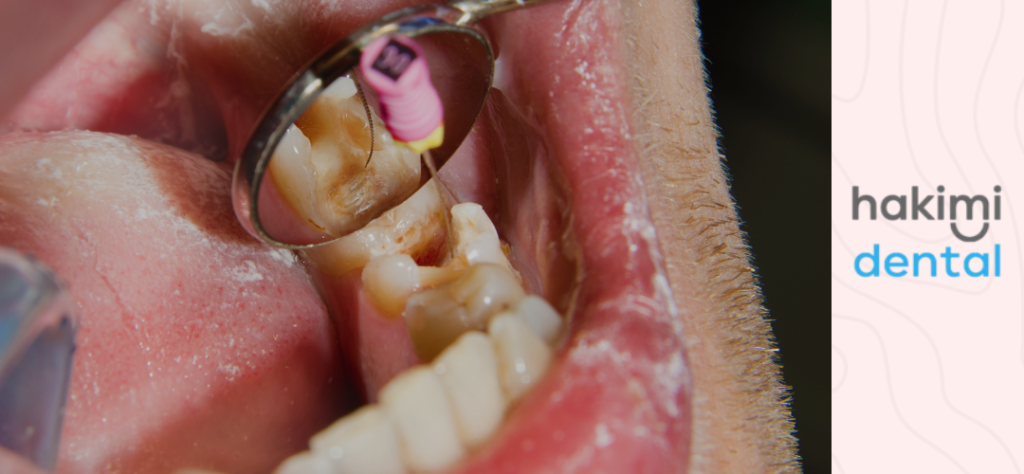
What Is Root Canal Treatment and Why Is It Needed?
Before getting to the timing, it helps to understand what root canal treatment actually involves — because the procedure’s complexity, and therefore its duration, makes more sense once you understand what the dentist is doing and why.
Inside every tooth, beneath the hard enamel and dentine, sits the dental pulp: a soft tissue containing blood vessels, nerve fibres and the cells responsible for forming dentine. The pulp runs from the chamber inside the crown of the tooth down through the root canals to the tip of each root.
Root canal treatment becomes necessary when the pulp becomes irreversibly inflamed or infected. This typically happens because:
- Tooth decay has progressed through the enamel and dentine and reached the pulp
- A crack or fracture in the tooth has allowed bacteria to access the pulp
- Repeated dental procedures on the same tooth have caused cumulative damage to the pulp
- A blow or trauma to the tooth has damaged the blood supply
Once bacteria reach the pulp, the resulting infection cannot be resolved with antibiotics alone. The only definitive treatment is to remove the infected pulp tissue, clean and shape the root canal system, and seal it to prevent reinfection. This is what root canal treatment does — and it is what saves the tooth from extraction.
How Long Will a Root Canal Take? The Key Factors
The answer to how long will a root canal take depends primarily on four things: which tooth is being treated, how many root canals that tooth has, whether there is an active infection, and whether the case is straightforward or complex. Here is how each of these affects the time.
Which Tooth Is Being Treated?
This is the single most important factor in determining how long a root canal appointment will take.
- Front teeth (incisors and canines) typically have one root canal each. They are the most straightforward teeth to treat and usually require the least time — often 45 to 60 minutes for a single appointment.
- Premolars can have one or two root canals depending on whether they are upper or lower jaw teeth, and whether the root has divided. Premolar root canal treatment typically takes 60 to 90 minutes.
- Molars are the most time-consuming. Upper first molars commonly have three or four canals; lower molars typically have two or three. Each canal must be individually located, cleaned, shaped and filled. A molar root canal treatment typically takes 90 minutes to two hours per appointment, and is more likely to require two visits.
The position of the tooth also affects access. Teeth at the back of the mouth are harder to reach and visualise, which adds time to even technically straightforward cases.
The Number of Root Canals
Each individual canal within a tooth needs to be located, negotiated with fine instruments, cleaned to remove infected tissue, shaped to allow effective irrigation and filling, and sealed. A tooth with four canals takes roughly four times as long to treat as a tooth with one canal — this is the most direct relationship in determining how long a root canal will take.
Occasionally, a tooth will have an additional canal that is not visible on the initial X-ray. Locating and treating accessory canals adds time to the procedure and is one of the reasons that post-operative X-rays are taken to confirm that the full canal system has been addressed.
Active Infection and Abscess
When root canal treatment is carried out on a tooth with an active abscess, there are two important effects on timing:
First, infected tissue is acidic, and acidic environments reduce the effectiveness of local anaesthetic. This means that achieving adequate numbness in an acutely infected tooth can take more time, and sometimes requires additional anaesthetic or alternative techniques. If you have been told that root canal treatment on an infected tooth is harder to numb, this is the clinical reason why.
Second, in cases of severe infection, the dentist may choose to carry out the first stage of treatment — opening the tooth, draining the abscess and cleaning the canals — and then prescribe antibiotics before completing the treatment at a second appointment once the infection has settled. This two-visit approach is not a sign that something has gone wrong; it is often the most clinically appropriate way to manage an active infection.
Case Complexity
Some teeth present additional complexity: curved roots that require careful negotiation, heavily calcified canals that have narrowed with age or previous trauma, previous root canal treatment that needs to be redone, or canal anatomy that is unusual. These cases take longer and are sometimes referred to an endodontist — a specialist in root canal treatment — rather than being managed at a general dental practice.
A Typical Root Canal Appointment: What Happens Step by Step
Understanding what actually happens during the procedure answers the question of how long a root canal takes far more usefully than any single number.
Step 1: Anaesthetic (5–10 Minutes)
The procedure begins with local anaesthetic. For most teeth, this takes effect within five to ten minutes. As noted above, infected teeth may require additional time and additional anaesthetic to achieve full numbness. A root canal should not be painful during the procedure — if you feel sharp pain rather than pressure, you tell your dentist and additional anaesthetic is given.
Step 2: Dental Dam Placement (2–5 Minutes)
A thin sheet of rubber called a dental dam is placed around the tooth to isolate it from the rest of the mouth. This keeps the area dry, prevents contamination from saliva, and protects you from swallowing the fine instruments used during treatment. It is a standard safety measure and makes the procedure both safer and more effective.
Step 3: Access Cavity Preparation (5–15 Minutes)
The dentist drills through the crown of the tooth to create an opening into the pulp chamber. This access cavity is the gateway through which all subsequent instruments are passed. The size and location of this opening varies depending on the tooth type.
Step 4: Canal Location and Working Length Determination (10–20 Minutes)
Each canal must be located within the pulp chamber — some are obvious, others require careful probing. Once located, a small electronic device called an apex locator is used to determine the precise length of each canal from the access opening to the root tip. This working length is critical: cleaning too short leaves infected tissue behind; going too far risks damaging the tissues beyond the root apex.
Step 5: Cleaning and Shaping (20–60 Minutes)
This is the most time-consuming part of the procedure and where the number and curvature of the canals has the greatest effect on overall duration. A series of progressively larger instruments — either hand files or rotary nickel-titanium instruments — are used to clean the canal walls of infected tissue and shape the canal into a form that allows thorough irrigation and effective filling.
Between each instrument, the canals are irrigated with sodium hypochlorite (a disinfectant solution) to flush out debris and kill remaining bacteria. The irrigation step is as important as the mechanical cleaning — thorough disinfection of the canal system is central to the long-term success of the treatment.
For a single-canal front tooth, cleaning and shaping might take 20 minutes. For a four-canal upper molar, it can take an hour or more.
Step 6: Obturation — Filling the Canals (15–25 Minutes)
Once the canals are clean, dry and shaped, they are filled with a material called gutta-percha — a rubber-like material that, combined with a sealing cement, fills the canal space and prevents bacteria from re-entering. The gutta-percha is usually placed using a technique called warm vertical compaction, which adapts the material intimately to the canal walls and any lateral branches.
A final X-ray is taken to confirm that the canals have been filled to their full working length.
Step 7: Temporary or Permanent Restoration (10–20 Minutes)
The access cavity is sealed with either a temporary filling (if a second appointment is planned) or a permanent restoration. In most cases, a tooth that has had root canal treatment will ultimately need a crown to protect it from fracture, as the tooth becomes more brittle once the pulp is removed. This is planned as a subsequent appointment and is not part of the root canal procedure itself.
Single Appointment vs Two Appointments: Which Is Better?
Whether root canal treatment is completed in one visit or two is a clinical decision, not a matter of preference. Here is the current evidence-based position:
Single-visit root canal treatment is appropriate for most cases where:
- There is no active abscess or spreading infection
- The tooth is not causing acute symptoms that would prevent adequate anaesthesia
- The canal anatomy is manageable within a single session
- The patient is medically fit and able to tolerate a longer appointment
Single-visit treatment has the advantage of fewer appointments, no risk of contamination between visits, and no period with a temporary filling that might break or leak. Research comparing single and multi-visit root canal treatment shows broadly equivalent success rates when appropriate case selection is applied.
Two-visit treatment is preferable when:
- There is an active abscess with significant infection
- The tooth cannot be fully anaesthetised in one visit
- The canal system is complex and cannot be fully cleaned in a single session
- A calcium hydroxide inter-appointment dressing is needed to continue disinfecting the canals between visits
If your dentist recommends two appointments, this is the clinically correct decision for your specific situation — not a sign that the treatment is going badly.
Does Root Canal Treatment Hurt?
The honest answer is: it should not hurt during the procedure itself, and most patients are surprised by how manageable it is. The fear of root canal treatment is largely based on the pain of the toothache that makes it necessary, not the treatment itself.
Under effective local anaesthetic, you will feel pressure, movement and vibration — but not sharp pain. If you do feel pain during the procedure, more anaesthetic is given. Modern anaesthetic techniques are very effective, and the era of painful root canal treatment belongs firmly in the past.
After the appointment, once the anaesthetic wears off, some soreness and sensitivity is normal for two to five days. The tooth may feel tender when biting down, and the gum around it may be slightly sore. Over-the-counter pain relief — ibuprofen and paracetamol — manages this well for the vast majority of patients. Severe pain, swelling or a fever after treatment are reasons to contact your dentist, as these can indicate a complication that needs assessment.
If you are currently in acute dental pain and need to be seen urgently, our emergency dentist service in Oldbury is available from just £25 for an emergency appointment. We will assess your tooth, provide pain relief where possible, and discuss whether root canal treatment or another course of action is the right next step.
What Happens After Root Canal Treatment?
Once root canal treatment is complete, the tooth needs a permanent restoration to protect it. In most cases, this means a dental crown, which covers the entire visible portion of the tooth and distributes bite forces across the full circumference rather than concentrating them on the remaining tooth structure.
A root-canal-treated tooth can last as long as any other tooth if it is properly restored and maintained. The key factors for long-term success are:
- Thorough cleaning during the procedure (which is why adequate appointment time matters)
- Complete sealing of the canal system to prevent bacterial reinfection
- A well-fitting permanent crown placed promptly after treatment
- Ongoing good oral hygiene and regular dental check-ups to monitor the tooth
Regular dental hygienist appointments are also important — keeping the gum tissue and bone around the treated tooth healthy is as important as the restoration on top of it.
Root Canal Treatment at Hakimi Dental Clinic, Oldbury
At Hakimi Dental Clinic on New Birmingham Road in Oldbury, root canal treatment starts from £345 — a clear, accessible price for a procedure that, at many practices, carries significantly higher fees.
We also offer dental check-ups from just £35 and emergency appointments from £25, reflecting our commitment to making quality dental care accessible to patients across Oldbury and the wider Birmingham area.
If you have been told you need root canal treatment, or if you are in dental pain and need to be assessed urgently, our team is here to see you, explain your options clearly, and carry out treatment to the highest clinical standard.
The Bottom Line
So, how long will a root canal take? For most patients:
- A single-canal front tooth: 45 to 60 minutes, usually one appointment
- A premolar: 60 to 90 minutes, one or occasionally two appointments
- A molar: 90 minutes to two hours per appointment, sometimes two visits
The exact time depends on the number of canals, the degree of infection, the complexity of the canal anatomy and the specifics of your case. Your dentist will give you a realistic estimate before treatment begins.
What matters more than the exact duration is that the procedure is carried out thoroughly — rushed root canal treatment that misses a canal or leaves infected tissue behind is not a saving of time, it is a source of future problems. At Hakimi Dental Clinic, we take the time to do it properly.
Disclaimer
The information in this article is intended for general guidance only and does not constitute personalised dental or medical advice. Treatment timelines vary depending on individual clinical circumstances. Please book an appointment with a qualified dental professional for a proper assessment and accurate advice specific to your situation.
Hakimi Dental Clinic is a dental practice at 51a New Birmingham Road, Oldbury, B69 2JF, offering root canal treatment from £345, dental check-ups from £35, emergency dental appointments from £25, dental hygiene appointments, Invisalign, composite bonding, porcelain veneers, teeth whitening, dental crowns and smile makeovers.
FAQs about root canal treatment
Molar root canal treatment typically takes 90 minutes to two hours per appointment, and is more likely than other teeth to require two visits. This is because molars have two to four root canals, each of which must be individually located, cleaned, shaped and filled. Upper first molars in particular often have four canals, making them among the most time-intensive teeth to treat. Your dentist will advise you on the likely number of appointments after examining your tooth and X-rays at your first visit.
Yes, in many cases. Single-visit root canal treatment is appropriate for most straightforward cases without active infection. Research shows that single and two-visit treatment have comparable success rates when cases are selected appropriately. If two visits are recommended, it is for a specific clinical reason — usually an active abscess or canal complexity — not simply a scheduling preference.
Most patients can return to work the same day or the following day after root canal treatment. Post-operative soreness and tenderness on biting are normal for two to five days and are managed with over-the-counter pain relief. You should avoid biting on the treated tooth until your permanent crown or filling is in place. If you have a physically demanding job or one that requires significant talking or exertion, you may prefer to take the rest of the day off after a longer appointment.
Delaying treatment once an infected or irreversibly inflamed pulp has been identified allows the infection to progress. The bacterial infection at the root tip can spread into the surrounding bone, causing increasing bone loss, a worsening abscess, and potentially spreading to adjacent teeth or soft tissues. In some cases, a tooth that could have been saved with timely root canal treatment becomes so compromised that extraction is the only remaining option. If you are experiencing dental pain and need to be seen urgently, our emergency dentist service can assess you promptly from £25.
The most common signs that root canal treatment may be needed include: a toothache that is persistent, spontaneous or worsens at night; prolonged sensitivity to heat or cold that does not settle after the stimulus is removed; pain when biting down; visible swelling in the gum alongside a tooth; a raised, shiny swelling on the gum (a dental abscess); or a tooth that has changed colour and become grey or dark. Some teeth that need root canal treatment cause no pain at all — which is why regular dental check-ups with X-rays are the most reliable way to catch pulpal problems before they become acute.